
- HOME
- Q&A
Q&A
The purpose and types of local exhaust equipment
During experiments, various chemicals are used, and the gaseous substances or particles produced by their interactions can disperse into the air, potentially having a significant impact on human health. For this reason, local exhaust ventilation equipment is indispensable for protecting researchers. Among the various types of local exhaust ventilation equipment, there are three main categories: exterior hoods, receiving hoods, and enclosing hoods.
Exterior hood:It is recommended to install the system near the source of contamination so that harmful gases can be extracted immediately after they are generated.
Receiving hood:The system should be positioned in the direction of the airflow from the pollution source, allowing for the extraction of contaminants along the direction of dispersion.
Enclosing hood:The hood is designed with an opening only on the side where operations are conducted, and the inflow of air helps guide the harmful gases out of the cabinet. This allows for more efficient extraction at lower air volumes and reduces susceptibility to disturbances from surrounding airflow.
The enclosing type mainly refers to fume hoods. A basic fume hood must have, in addition to suitable operating space, power for experimental equipment, and the supply of gases and liquids required for use, as well as a variable sash window made of glass to facilitate the entry and exit of materials and ensure the safety of the operator.
在需設置新的局部排氣裝置時,請諮詢專門的實驗室排風工程廠商,以利依據您現場既有的排氣設備狀況與排氣相關法規來為您規劃最適合的設備。
以上為誠陽實驗室設備介紹之實驗室局部抽氣設備種類,提供給各位參考
參考資料:
1-1.目的と種類of REHSE_Sub Working Group (rehse2007.com)
認識整體換氣&局部排氣 - 工安百科 (ipedia.tw)
厚生勞動省文件
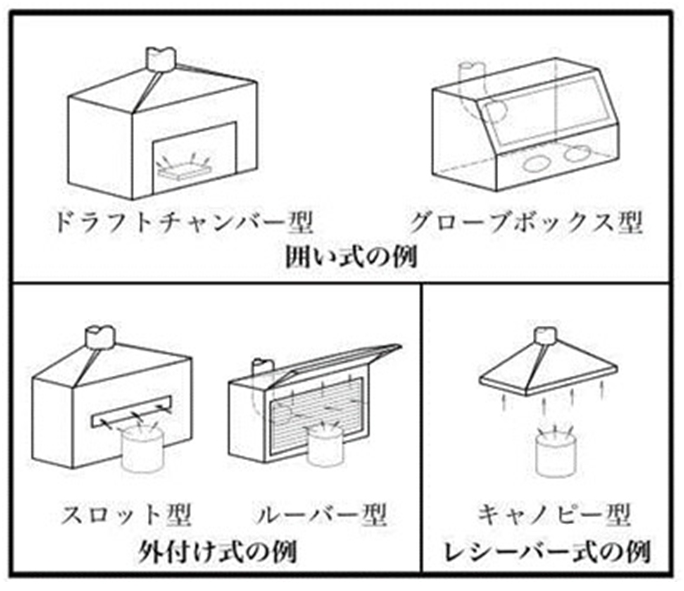
Exterior hood:It is recommended to install the system near the source of contamination so that harmful gases can be extracted immediately after they are generated.
Receiving hood:The system should be positioned in the direction of the airflow from the pollution source, allowing for the extraction of contaminants along the direction of dispersion.
Enclosing hood:The hood is designed with an opening only on the side where operations are conducted, and the inflow of air helps guide the harmful gases out of the cabinet. This allows for more efficient extraction at lower air volumes and reduces susceptibility to disturbances from surrounding airflow.
The enclosing type mainly refers to fume hoods. A basic fume hood must have, in addition to suitable operating space, power for experimental equipment, and the supply of gases and liquids required for use, as well as a variable sash window made of glass to facilitate the entry and exit of materials and ensure the safety of the operator.
在需設置新的局部排氣裝置時,請諮詢專門的實驗室排風工程廠商,以利依據您現場既有的排氣設備狀況與排氣相關法規來為您規劃最適合的設備。
以上為誠陽實驗室設備介紹之實驗室局部抽氣設備種類,提供給各位參考
參考資料:
1-1.目的と種類of REHSE_Sub Working Group (rehse2007.com)
認識整體換氣&局部排氣 - 工安百科 (ipedia.tw)
厚生勞動省文件
 TEL
TEL FAX
FAX ADD
ADD E-Mail
 Facebook
 LINE
LINE Shopee